Beyond OTP for fraud: the identity-confidence stack
A framework for thinking about identity confidence as a layered stack — Verify, Trust, Detect — rather than as a single OTP-or-not decision. Includes worked examples and a vendor evaluation checklist.
Most enterprise teams still talk about identity as a binary: the customer is verified or not. OTP arrived or not. Match or not. The teams that have moved past that frame think about identity as a stack of compounding confidence signals, where every decision is made with the right combination of layers for that decision's risk profile. This post is the framework.
Why "fraud score" is the wrong frame
Fraud scoring is a single number that estimates the probability the current transaction is fraudulent. It is a useful number. It is also the wrong place to start when designing an identity architecture.
The problem with starting from a fraud score:
- It collapses very different signals into one dimension. Identity, intent, and transaction risk are different kinds of question.
- It is brittle to attacker adaptation. A score-trained on historical fraud is always one step behind the patterns that have not appeared yet.
- It is hard to explain. "The score said no" is a poor answer to a compliance auditor and a worse answer to an unhappy customer.
The teams that build identity architectures around fraud scores tend to end up with the same problem: high false positives, opaque decisions, no clear escalation path when the score is wrong.
The teams that build around an identity-confidence stack tend to compose better, explain better, and adapt faster. The fraud score becomes one consumer of the stack — not the entire architecture.
The three layers
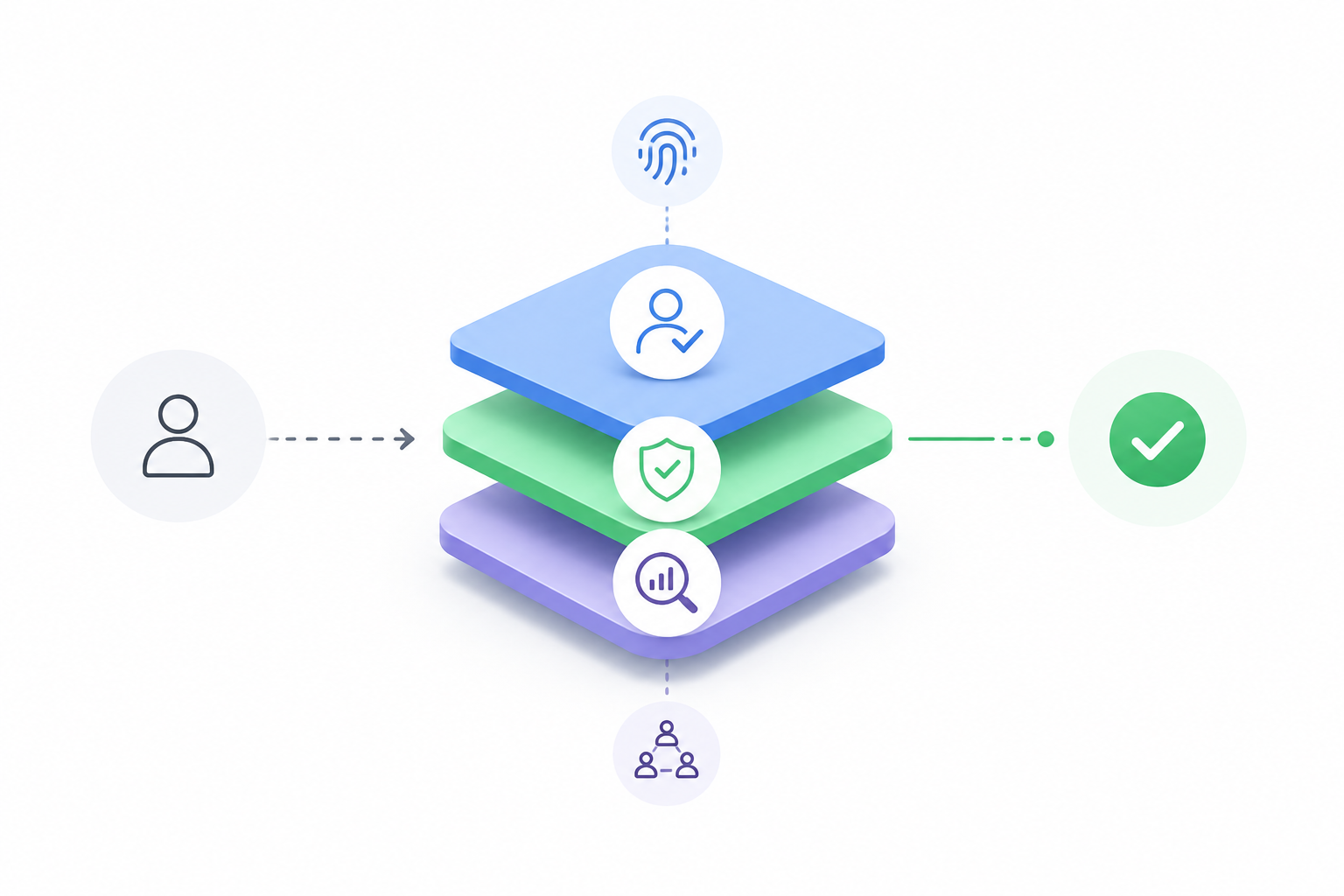
The identity-confidence stack has three layers, each answering a different question:
Layer 1 — Verify (who the customer is)
This layer answers "is this customer who they claim to be at this moment?" It is the identity-establishment layer. Silent mobile verification, document verification, and biometric checks all live here.
Properties of the Verify layer:
- Point in time. Identity is established at a moment — sign-in, account creation, high-value action.
- Binary outcome with confidence. Verified yes/no/unverifiable, with a confidence number attached.
- Strong signal. When a Verify check succeeds, you have high-quality identity knowledge.
What the Verify layer is not: it is not a continuous signal. A successful verification two hours ago does not mean the same customer is still on the device now. That is Layer 2.
Layer 2 — Trust (how confident we are, right now)
This layer answers "given everything we know about the current session, action, and context, how much should we trust the customer right now?" It is continuous, not point-in-time. It is contextual, not absolute.
Properties of the Trust layer:
- Continuous. Re-evaluated on every sensitive action, not just at sign-in.
- Composable. Takes Verify outcomes as one input, adds device, behavior, geography, transaction context.
- Explainable. Produces a score with the top contributing signals so decisions can be audited.
The Trust layer is where most of the real-time decisions get made. Approve, step up, review, block — these are Trust-layer decisions informed by Verify-layer inputs.
Layer 3 — Detect (what is happening across the customer base)
This layer answers "what patterns are emerging across our customers that we should act on?" It is the surveillance-and-response layer. Behavior analytics, anomaly detection, and abuse pattern recognition live here.
Properties of the Detect layer:
- Cross-customer. Looks at patterns across the population, not just the current session.
- Time-windowed. Identifies emerging behaviors in minutes-to-hours rather than real-time milliseconds.
- Action-producing. Emits signals that feed back into Trust (raise the score threshold on this device segment) and into Verify (require stronger identity check for this attack pattern).
The Detect layer is what catches the new attack pattern that has not been seen before — the velocity anomaly, the unusual identity-graph cluster, the abuse burst.
How the layers compose
The composition pattern that works:
Verify produces an identity outcome     →
Trust ingests Verify + context          →
Decision: approve / step-up / block     →
Detect watches for population patterns  →
Detect feeds back into Trust thresholds →
This is a cycle, not a pipeline. Detect informs Trust which calls Verify which feeds Detect. The composition is what makes the whole stack adapt.
A worked example
Take a customer making a $1,500 payout from a fintech account, on a device they have used before, from a city they have been in before.
- Verify (at sign-in earlier in session): silent mobile verification succeeded. Identity confidence: high. This is one input to Trust.
- Trust (at the moment of the payout): identity ✓, device ✓, geography ✓, behavior ✓, amount within normal pattern. Composite score: 94. Auto-approve.
- Detect (cross-customer surveillance): no unusual pattern on this device segment, no velocity anomaly. No threshold adjustment needed.
The payout proceeds in under a second with full audit trail.
Now run the same scenario with a payout to a new beneficiary in a country the customer has never paid to, from a device that signed in 8 hours ago:
- Verify: the original sign-in verification is now 8 hours old. Trust will request a re-verification because the action is sensitive.
- Trust: identity-stale, beneficiary-new, country-new. Composite score: 41. Step-up required.
- Verify (step-up): silent re-verification triggered, succeeds. Identity refreshed. Trust score moves to 78.
- Trust (re-evaluated): auto-approve with high-value-action flag for back-office review.
- Detect (cross-customer): if this pattern (new device + new beneficiary + new country) starts clustering across customers, raise the step-up threshold for that pattern.
Same architecture, different decision, both auditable, both explainable.
Where each Authmatech product sits in the stack
To be explicit (this is the architecture we built the product around):
- Layer 1 (Verify): Authmatech Verify for silent identity confirmation, Verify+ for assisted recovery, Web for cross-device.
- Layer 2 (Trust): Authmatech Trust for real-time confidence scoring, Shield for risk-aware step-up.
- Layer 3 (Detect): Authmatech Detect for behavior and anomaly signals.
You do not have to buy the whole stack from one vendor. You should have the whole stack — composed of whatever vendors fit — because each layer answers a question the others cannot.
A vendor evaluation checklist
If you are evaluating identity vendors and want to map them to the stack:
For a Verify-layer vendor
- Does the verification produce a signed outcome you can trust on the application side?
- Is there a fall-through path for unverifiable states (Wi-Fi, VPN, roaming)?
- What is the end-to-end p95 latency on your real traffic, not the demo traffic?
- How is customer identity data handled — encryption at rest, audit logging, jurisdiction?
For a Trust-layer vendor
- Does the score arrive in under 500ms in-line with your decision flow?
- Is the score explainable — top contributing signals exposed per decision?
- Can thresholds be tuned per-workflow without redeploying?
- Does it compose with your existing fraud engine as a signal source, or does it demand to be the engine?
For a Detect-layer vendor
- Does it surface patterns in minutes, not days?
- Does it expose the signal to your existing incident pipeline (webhook, SIEM, ticketing)?
- Is the signal precision tunable for your team's false-positive tolerance?
- Are the pre-built signal types relevant to your vertical, or generic?
What to avoid
A few architectural anti-patterns we see often:
- Treating Trust as Detect. Trust is real-time per-decision; Detect is windowed cross-customer. Conflating them produces both slow decisions and shallow signals.
- Skipping Verify because you have Trust. Trust without Verify is guessing. Trust scoring needs a strong identity anchor to be useful.
- Buying Detect without acting on the signal. Detect produces alerts. Alerts that no one acts on are noise that erodes the team's response capability over time.
- Single-vendor lock-in across all three layers. Sometimes the right answer is one vendor for the whole stack. Often it is not. Architect for layered choice from day one.
Where to start
If your current identity architecture is "OTP and a fraud score," the highest-leverage move is usually:
- Replace OTP with silent mobile verification in the Verify layer. Conversion and security both move the right way.
- Add a Trust layer — even a thin one. Re-evaluate identity confidence at the sensitive actions, not just at sign-in.
- Build the Detect layer last, when the signal coverage justifies the operations team to act on it.
Most enterprises do steps 1 and 2 in a single quarter, then expand to step 3 over the following two. The architecture compounds — each layer makes the others stronger.
The Authmatech solutions team will sit on a call and map your existing stack against this framework, with honest gap analysis. Bring your current architecture; we will bring the patterns we have seen work and the ones we have seen break.
The shorter version: stop thinking about identity as a single OTP-or-not decision and start thinking about it as a three-layer stack — Verify, Trust, Detect. Each layer answers a different question. Each layer composes with the others. The stack adapts to attack patterns that a single fraud score never could. The architecture is buildable today and pays for itself the same quarter you ship the first layer.