
The anonymous visitor problem: why 97% of your traffic disappears (and what to do about it)
Most enterprise sites convert single-digit percentages of their traffic. The rest disappears into anonymity. This is a clear-eyed look at why that happens, what the legacy fixes get wrong, and how mobile identity intelligence is changing the math.
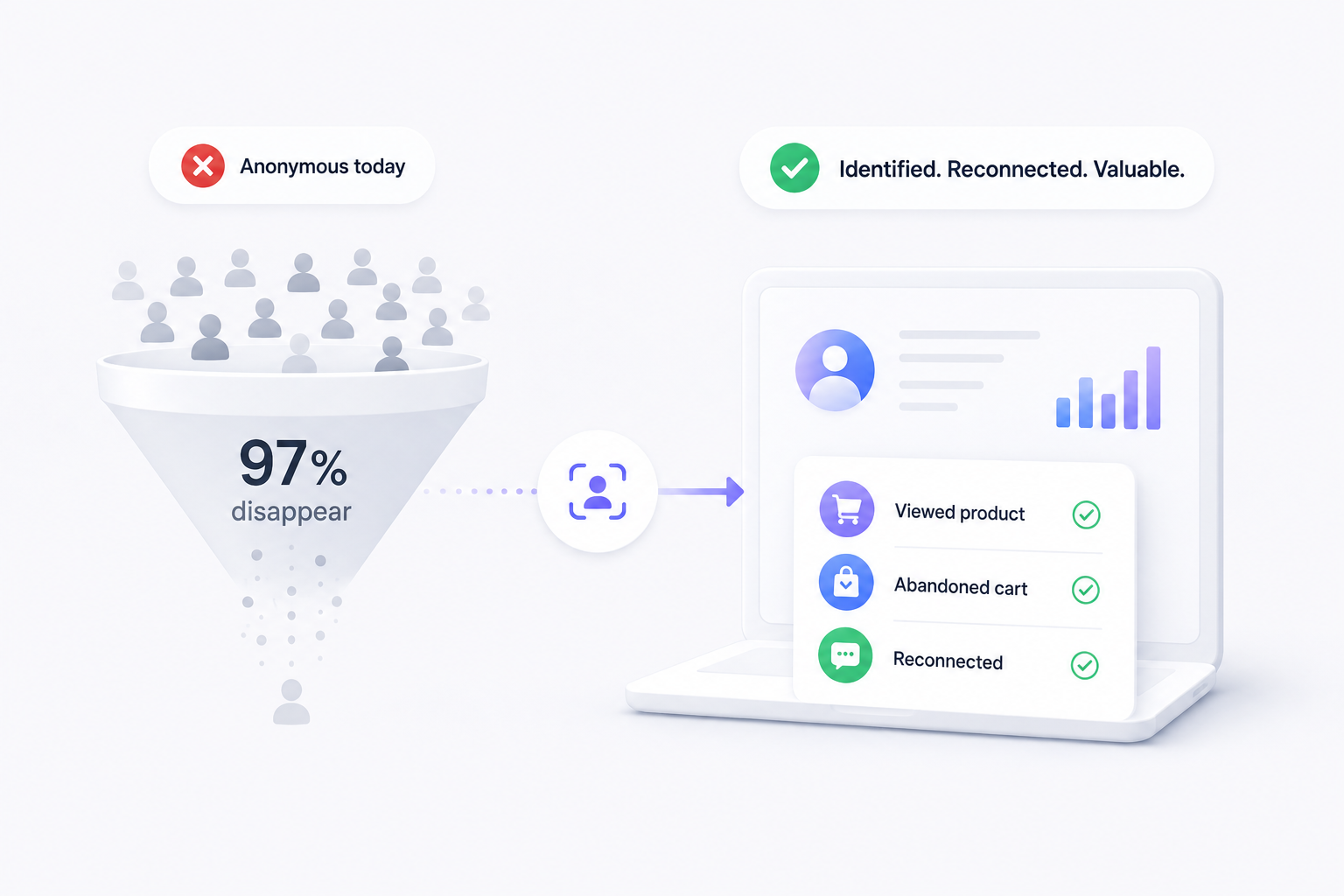
The honest number for most enterprise marketing teams is uncomfortable. Across e-commerce, financial services, travel, and on-demand applications in MENA, between 95% and 98% of the traffic that arrives on a brand's site or app leaves without ever signing in, identifying themselves, or completing a purchase. The marketing dashboard shows visitors, sessions, and clicks. The CRM shows almost none of it. The gap between those two realities — what we call the anonymous visitor problem — is the single largest unaddressed waste in modern customer acquisition.
This post explains the size of that gap, why the legacy fixes (cookies, fingerprinting, email re-engagement) are no longer fit for purpose, and what enterprise teams are using in 2026 to recover the visitors who used to disappear.
How big is the gap, really
The numbers cited at industry conferences are often optimistic. The numbers most marketing teams actually see in their own funnels look like this:
- 2–4% of visitors complete a primary conversion on first session in mature e-commerce.
- 0.5–1.5% is the realistic conversion rate for many B2C financial services first sessions.
- 30–60% of visitors come back at least once before any conversion happens. That return traffic is also largely anonymous if no identification took place on the first visit.
- 45–80% of paid-traffic conversions in MENA happen on a different session than the one driven by the ad. The first session pays the ad bill; the converting session is cookie-less or has lost session continuity, and attribution misses the connection.
The takeaway is not that enterprise sites are bad at conversion. It is that conversion is a long, fragmented, multi-session journey, and the majority of the audience participating in that journey is invisible.
Why the legacy fixes stopped working
The traditional toolkit for resolving anonymous traffic was built for an internet that no longer exists.
Third-party cookies. The end of the third-party cookie has been a slow rollout — but the practical impact in 2026 is that any attribution model built on third-party cookies underreports, misattributes, or simply silently fails. ITP, ETP, and the major mobile operating systems have closed the loop on cross-site identity inference. The MENA mobile audience runs on iOS and Android in roughly even split, and both vendors have made third- party cookies functionally dead.
Browser fingerprinting. Once a credible identity recovery technique, fingerprinting has been deprioritized for two reasons: regulator pressure under PDPL, GDPR, and the emerging UAE data law; and active browser-vendor counter-measures (randomized canvas output, headers normalization, query-string stripping). Fingerprints decay quickly enough that the audience graph built on them is mostly stale within weeks.
Email re-engagement. Email still works when you have an address, but it does not help you with the anonymous session. By the time a visitor has provided an email, they are no longer in the anonymous-visitor segment — and the deepest abandonment is on the visitors who never gave you an email in the first place.
Retargeting pixels. The retargeting model has the same dependency tree as third-party cookies, plus growing ad-platform constraints on identifying audiences. The pixels still fire; the audiences they build are smaller, noisier, and less actionable than the dashboards suggest.
What this leaves enterprise teams with is a marketing operation that knows it is spending real money to acquire visitors it cannot recognize on the next visit, cannot reconnect to a CRM record, and cannot reach via any channel other than the one the ad platform chose for it.
What changed: mobile identity intelligence
The category that has emerged to fill this gap is mobile identity intelligence — identifying anonymous visitors via the mobile identity they already carry, under explicit consent, and turning them into reachable customer records. The technology is the same foundation that powers silent verification: the mobile network already knows who the device on the other side of the request belongs to, and modern identity platforms can surface that intelligence under regulator-approved consent flows.
In practice this looks like:
- A visitor browses a luxury watch on an e-commerce site. They add it to the cart. They abandon. With cookie-only attribution they are anonymous and lost.
- With mobile identity intelligence, they are recognized as a returning customer — under the consent context they previously established with the brand — and the abandonment becomes a reconnection opportunity rather than a dead end.
- The reconnection happens on a verified mobile channel, in the brand's own voice, with the cart context preserved. The customer who would have churned converts.
The privacy posture is what makes this work in MENA. Mobile identity intelligence is strictly consent-aware: identification only happens for visitors who have an existing consent relationship with the brand, established through a prior verified interaction or an explicit opt-in. Raw identity data is never exposed to the application. The customer sees a coherent, brand-aligned recognition, not a creepy ad-tech experience.
The conversion math no one is talking about
For most enterprise teams, the operational value of identifying previously-anonymous visitors falls into three buckets:
- Recovered carts. The single largest concrete win. A 3–5 percentage-point lift in completed transactions on previously-abandoned carts is realistic on the first 90 days of deployment.
- Reattributed acquisition. Paid traffic that converts on a later session is correctly attributed to the first session that brought it in. Marketing spend reallocates toward the channels that genuinely produce customers, not the channels that produce the click that closes the deal.
- Cleaner CRM, deeper journey context. Every recognized visitor enriches the CRM profile with the actual journey behind the conversion. Support, marketing, and operations teams stop guessing.
The math is unforgiving in both directions: if you have low traffic, the absolute lift is small; if you have high traffic, the unrecovered audience is enormous and the absolute lift is large. For an e-commerce site running $20M in annual revenue with a typical 2% conversion rate, recovering even a single percentage point of previously-anonymous audience can be the largest revenue lever the marketing team will ship that year.
What it does not do
Mobile identity intelligence is not a substitute for the basics. It will not:
- Identify brand-new visitors who have no consent context with the brand.
- Replace your ad-platform measurement.
- Fix product-market fit problems disguised as conversion problems.
- Help you market to people who never want to hear from you.
It will only do the one thing it does well: turn previously-anonymous traffic with a consent relationship into reachable, reconnectable customer records that your team can act on.
Where to start
The cheapest first deployment is on the highest-intent moment in your funnel: the abandoned cart, the abandoned application, the abandoned checkout. That is where the revenue is concentrated, the customer intent is highest, and the reconnection lift is most measurable. Teams that start there typically expand from a single deployment to a full audience graph within one or two quarters.
If you want a model of what mobile identity intelligence would look like on your own traffic, the Authmatech solutions team will model it on your numbers and walk through the privacy posture in detail. We will tell you honestly if the audience is not large enough to justify the work — the math is either there or it is not.
The shorter version: the anonymous visitor problem is enterprise marketing's largest unaddressed line item. The legacy toolkit no longer fixes it. Mobile identity intelligence is the category that does, with a privacy posture built for MENA from the start. The teams that move first will turn their largest blind spot into their largest conversion advantage.